A golf scorecard is an essential tool for tracking performance during a round of golf. It records the number of strokes a player takes on each hole while providing important course information, including par, yardage, and handicap. Whether you are a beginner learning the game or an experienced golfer participating in a tournament, a scorecard helps you monitor your progress and understand your performance.
Most golf courses provide scorecards for players, but having a printable golf scorecard template can be useful for practice rounds, friendly competitions, and personal recordkeeping. It provides an organized way to record scores, compare results, and review your performance after completing the course.
In this guide, you will learn what a golf scorecard is, understand its different sections, discover how to calculate golf scores, and find practical tips for keeping accurate records. You will also find printable golf scorecard designs suitable for different playing styles.
What Is a Golf Scorecard?
A golf scorecard is a printed or digital scoring sheet used to record a golfer’s performance during a round. It typically contains information about each hole, including its number, par, yardage, and handicap ranking.
Players use the scorecard to record the number of strokes taken on each hole. At the end of the round, individual hole scores are added together to calculate the player’s total gross score.
A standard golf course usually has 18 holes, although some courses offer nine-hole layouts. Most traditional scorecards are designed to accommodate an entire 18-hole round, with separate sections for the front nine and back nine.
A golf scorecard is useful for several purposes:
- Recording scores for every hole.
- Tracking total strokes during a round.
- Comparing performance against course par.
- Reviewing yardage and hole difficulty.
- Monitoring personal improvement.
- Recording scores during friendly games and official competitions.
Free Printable Golf Scorecard Templates
A printable golf scorecard template provides a convenient way to organize your game and keep track of important scoring information. Different layouts can accommodate individual players, multiple golfers, and more detailed performance tracking.
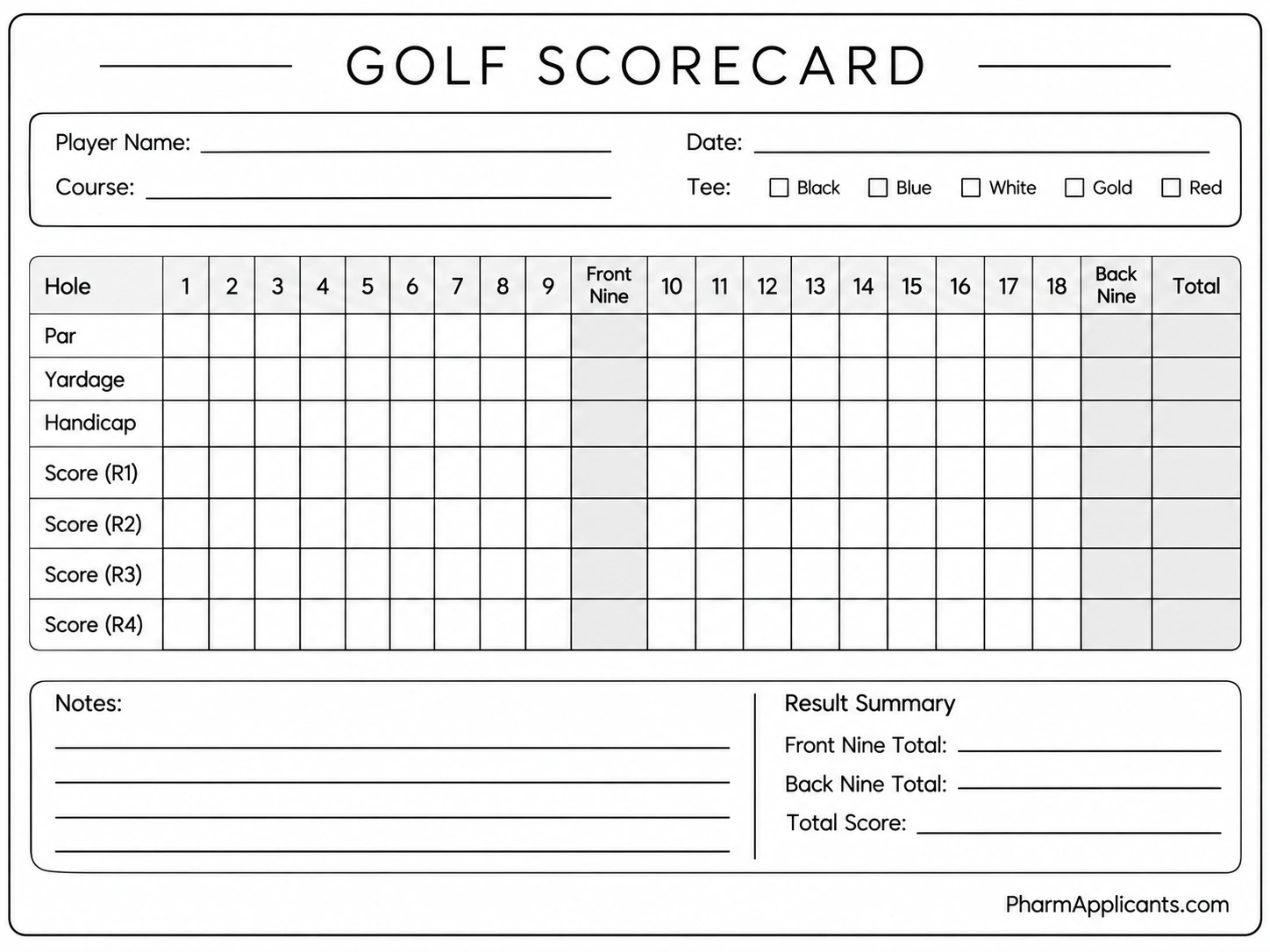
Classic Golf Scorecard Template
The classic design uses a simple scoring grid with spaces for all 18 holes, par, yardage, handicap, and player scores. It is suitable for everyday golf rounds and players who prefer a traditional layout.
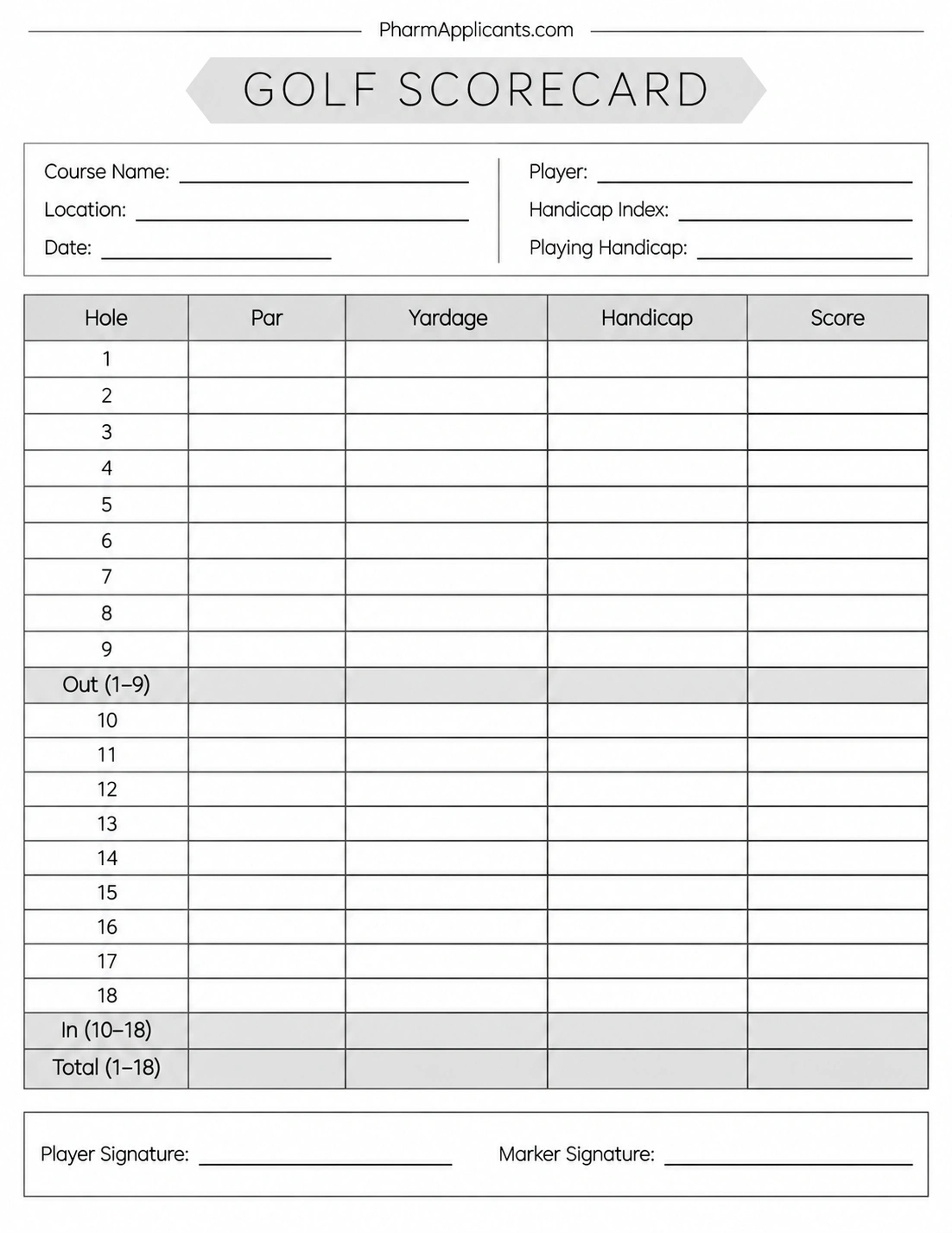
Professional Golf Scorecard Template
This design features a more structured layout with dedicated sections for player information, course details, handicap, and hole-by-hole scoring. It also includes signature spaces for verification.
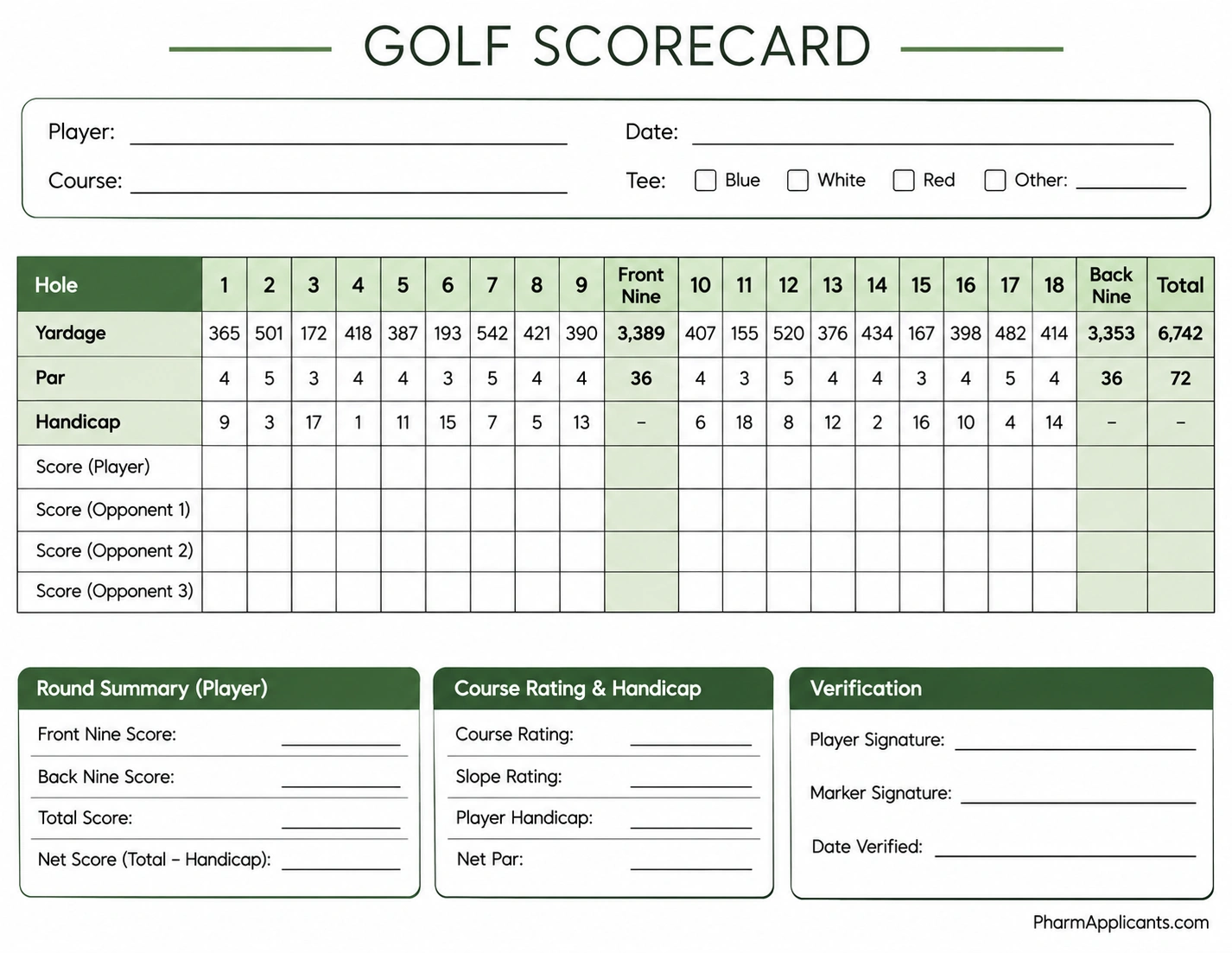
Modern Green Golf Scorecard Template
The modern green design uses subtle golf-inspired colors to distinguish important scoring sections. It provides space for multiple players, course ratings, handicap information, and round summaries.
Choose the layout that best matches your needs. You can print a copy for each round and keep completed scorecards to review your progress over time.
Understanding the Different Parts of a Golf Scorecard
A golf scorecard contains several sections that provide information about the course and help players record their performance. Understanding these details makes scoring easier and more accurate.
1. Hole Number
The hole number identifies each playing section of the golf course. A standard 18-hole course includes holes numbered from 1 through 18.
2. Par
Par is the expected number of strokes a skilled golfer should need to complete a hole. Most holes are classified as par 3, par 4, or par 5.
For example, a par 4 hole is expected to require four strokes to complete.
3. Yardage
Yardage indicates the measured distance of a hole from a particular teeing area to the designated green reference point. The distance can vary depending on the tee selected.
Yardage helps golfers evaluate the length of a hole and plan their shots accordingly.
4. Handicap or Stroke Index
The handicap ranking, often called the stroke index, indicates the relative difficulty of a hole for handicap purposes. It helps determine how handicap strokes are allocated in a handicap competition.
Depending on the course and competition, the scorecard may display stroke index rankings from 1 to 18.
5. Player Score
This section records the actual number of strokes taken by a player on each hole. The score should include applicable penalty strokes.
6. Front Nine and Back Nine
The front nine refers to holes 1 through 9, while the back nine covers holes 10 through 18. Separate subtotal sections make it easier to review performance during each half of the round.
7. Total Score
The total score represents the combined number of strokes taken across all 18 holes. It is calculated by adding the front nine and back nine scores.
How to Read and Use a Golf Scorecard
Using a golf scorecard is relatively simple once you understand the basic scoring system. Follow these steps to record your performance throughout a round.
Step 1: Enter Player and Course Information
Start by writing the player’s name, golf course, date, and selected tee. If you are playing with other golfers, make sure each player’s scoring row is clearly identified.
Step 2: Review Par and Yardage
Before starting each hole, check its par and yardage. These details provide useful information about the hole’s expected difficulty and playing distance.
Step 3: Record Strokes After Each Hole
Once a hole is completed, record the total number of strokes taken. Include penalty strokes when applicable.
For example, if you take five strokes on a par 4 hole, your score is one over par, commonly called a bogey.
Step 4: Calculate the Front Nine Total
After completing the first nine holes, add the individual scores to calculate your front nine total. This gives you an overview of your performance during the first half of the round.
Step 5: Record the Back Nine Scores
Continue recording your scores for holes 10 through 18. Add these scores together to calculate your back nine total.
Step 6: Calculate Your Overall Score
Add the front nine and back nine totals to determine your gross score for the entire round.
For example, if your front nine score is 42 and your back nine score is 45, your total gross score is 87.
Common Golf Scoring Terms You Should Know
Golf uses several scoring terms to describe a player’s performance relative to par. Learning these terms makes it easier to understand your scorecard.
- Albatross: Three strokes under par on a hole.
- Eagle: Two strokes under par.
- Birdie: One stroke under par.
- Par: The expected number of strokes for a hole.
- Bogey: One stroke over par.
- Double bogey: Two strokes over par.
- Triple bogey: Three strokes over par.
These terms help golfers describe their performance without having to compare every individual score with the hole’s par.
How to Calculate Golf Scores
Calculating a golf score involves adding the strokes taken on each hole. Players can also compare their total score with the course par to determine whether they finished under, over, or exactly at par.
Example of an 18-Hole Golf Score
Imagine a golfer completes a standard par 72 course with the following results:
- Front nine: 40 strokes.
- Back nine: 42 strokes.
- Total gross score: 82 strokes.
- Course par: 72.
The golfer finishes 10 strokes over par, commonly described as 10 over par.
Gross Score vs. Net Score
Gross score is the total number of strokes taken before handicap adjustments. Net score is calculated by subtracting the player’s applicable handicap allowance or playing handicap from the gross score, according to the competition format.
For example, a golfer with a gross score of 90 and an applicable playing handicap of 18 has a net score of 72.
Handicap calculations and allowances depend on the competition format and applicable handicap rules. Always follow the competition’s instructions when recording or calculating net scores.
Tips for Keeping an Accurate Golf Scorecard
Accurate scorekeeping is important for both casual rounds and competitive golf. A few simple habits can help prevent mistakes and make your records more useful.
- Record scores promptly: Write down the score after completing each hole rather than waiting until the end of the round.
- Include penalty strokes: Make sure your recorded score reflects all strokes and applicable penalties.
- Check the hole number: Confirm that each score is entered in the correct column.
- Review subtotals: Check your front nine, back nine, and total scores for accuracy.
- Keep scorecards organized: Store completed cards so you can review your playing history.
- Use a consistent format: Choose a scorecard layout that is easy to read and complete.
Official Golf Competition Scorecard Rules
In casual golf, players can use a scorecard mainly as a personal record. However, official stroke play competitions have additional scorecard responsibilities.
Under Rule 3.3b of the Rules of Golf, the marker is responsible for recording and certifying the player’s hole scores. After the round, the player must carefully check the recorded scores, ensure the marker has certified the card, certify the hole scores themselves, and promptly return the scorecard to the Committee.
It is important to check every hole before submitting the card. Returning a score lower than the actual score on a hole can result in disqualification, subject to the specific exceptions in the Rules. A higher score generally stands.
For official competitions, always follow the Committee’s scoring instructions and applicable competition rules.
Frequently Asked Questions About Golf Scorecards
What is a golf scorecard used for?
A golf scorecard is used to record the number of strokes a player takes on each hole. It also provides course information such as par, yardage, and handicap rankings, helping golfers track performance throughout a round.
How many holes are on a standard golf scorecard?
A standard golf scorecard usually contains 18 holes, divided into the front nine and back nine. Some scorecards are designed specifically for nine-hole rounds.
What does par mean on a golf scorecard?
Par represents the expected number of strokes needed to complete a hole. Common hole classifications include par 3, par 4, and par 5.
What is the difference between gross and net score?
Gross score is the total number of strokes taken during a round. Net score is the gross score adjusted by the applicable playing handicap under the relevant competition format.
What does handicap mean on a golf scorecard?
The handicap or stroke index identifies the relative difficulty ranking of each hole for handicap purposes. It helps determine where handicap strokes are allocated during handicap competitions.
Can I print my own golf scorecard?
Yes. You can print a golf scorecard template for personal practice, friendly games, and performance tracking. However, official competitions may require a specific scorecard or an approved electronic scoring method.
How do I calculate my total golf score?
Add the scores from all 18 holes. You can calculate the front nine and back nine subtotals separately before combining them to determine your final gross score.
Do golfers have to sign their scorecards?
In official stroke play competitions, the player must certify their hole scores, and the marker must also certify the recorded scores under Rule 3.3b. Follow the Committee’s instructions for submitting the card.
What happens if I submit an incorrect golf scorecard?
The consequences depend on the error. In stroke play, returning a score lower than the actual score on a hole generally results in disqualification, subject to specific exceptions. Returning a higher score normally means that higher score stands.
Conclusion
A golf scorecard is an important tool for recording scores, reviewing performance, and understanding course information. By tracking strokes, par, yardage, and handicap rankings, golfers can maintain accurate records and make better decisions throughout their rounds.
Using a printable golf scorecard template makes scorekeeping more organized and convenient. Whether you prefer a classic black-and-white layout, a professional scoring sheet, or a modern green design, choosing the right format can make it easier to track your game.
Download and print your preferred golf scorecard template, complete the course information, and record each hole as you play. With consistent scorekeeping, you can monitor your progress and make every round more meaningful.
Download: Golf Scorecard Template
