A grant proposal is an important document for organizations, nonprofits, educational institutions, and individuals seeking financial support for a specific project or program. It explains why funding is needed, what the project aims to accomplish, and how the requested money will be used. A well-written proposal can help convince potential funders that an idea is valuable, realistic, and worth supporting.
Whether you are applying for a government grant, nonprofit funding, an educational grant, or a private foundation grant, understanding how to prepare a professional proposal is essential. This guide explains the main sections of a grant proposal, provides practical writing tips, and includes a sample structure to help you get started.
What Is a Grant Proposal?
A grant proposal is a formal written request asking an individual, organization, foundation, or government agency to provide financial support for a specific project or program. It presents the project’s purpose, needs, objectives, implementation plan, budget, and expected results.
Unlike a loan, a grant generally does not require repayment. However, grant recipients are usually expected to use the funding according to the approved budget and project requirements. They may also need to submit progress reports and demonstrate how the money was spent.
The primary purpose of a grant proposal is to show potential funders that the proposed project addresses a genuine need and can achieve meaningful results with the requested financial support.
Why Is a Grant Proposal Important?
A grant proposal does more than request money. It gives funders a clear understanding of the project and helps them evaluate whether their investment will make a difference.
Here are several reasons why a professional grant proposal is important:
- Explains the project’s purpose: It describes the problem that needs attention and why the proposed project matters.
- Demonstrates project feasibility: It shows that the organization has a realistic plan, suitable resources, and the ability to complete the work.
- Builds funder confidence: A detailed proposal demonstrates professionalism, accountability, and organizational credibility.
- Clarifies financial requirements: It explains how much funding is needed and how the money will be allocated.
- Defines expected outcomes: It establishes measurable goals that help evaluate the project’s success.
A strong proposal connects the funder’s priorities with the project’s objectives. This makes it easier for reviewers to understand why the project deserves financial support.
What Should Be Included in a Grant Proposal?
Although grant application requirements vary between funding organizations, most proposals follow a similar structure. Each section serves a specific purpose and helps reviewers evaluate the project’s value and potential impact.
1. Executive Summary
The executive summary provides a brief overview of the entire project. It introduces the organization, explains the project’s purpose, identifies the target audience, and states the requested funding amount.
Keep this section concise and persuasive. Although it appears at the beginning, it is often easier to write after completing the other sections.
2. Statement of Need
The statement of need explains the problem or challenge that the project intends to address. It should provide clear evidence that the issue exists and requires attention.
Whenever possible, support your explanation with relevant statistics, research findings, community feedback, or other reliable information.
For example, a community education project might explain that local residents have limited access to educational resources and need additional learning opportunities.
3. Project Goals and Objectives
This section describes what the project intends to achieve. Goals explain the broader purpose, while objectives identify specific and measurable results.
Effective objectives should be realistic, clearly defined, and measurable within a specific period.
For example:
- Provide educational workshops for at least 300 participants within 12 months.
- Distribute learning materials to 10 local community centers.
- Increase participants’ knowledge by 25% based on evaluation surveys.
4. Project Methodology
The methodology explains how the organization will carry out the proposed project. It should describe the main activities, implementation process, resources, and responsibilities of the project team.
A clear methodology helps funders understand how the proposed objectives will be achieved.
5. Project Timeline
A project timeline outlines when each major activity will take place. It helps demonstrate that the organization has a realistic schedule for completing the proposed work.
You can organize the timeline by month, quarter, or project phase. Include important milestones such as preparation, implementation, monitoring, and final evaluation.
6. Project Budget
The project budget explains how much money is required and how the requested grant funding will be spent. Every expense should be reasonable, relevant, and connected to the proposed activities.
Common budget categories include:
- Personnel and project staff salaries.
- Equipment and supplies.
- Training and educational materials.
- Transportation and travel expenses.
- Administrative and operational costs.
- Monitoring and evaluation expenses.
Provide clear cost estimates and explain major expenses when necessary. The total budget should match the amount requested in the proposal.
7. Organizational Background and Qualifications
Funders want to know whether the applicant has the experience and resources needed to manage the project successfully.
Introduce your organization, its mission, relevant experience, previous achievements, and the qualifications of the people responsible for implementation.
If your organization has completed similar projects, include relevant results to strengthen your credibility.
8. Expected Outcomes and Evaluation
This section explains what changes the project is expected to produce and how those results will be measured.
Expected outcomes should connect directly to the project’s objectives. Explain which indicators, surveys, reports, or other evaluation methods will be used to measure progress.
For example, a job training program might measure the number of participants who complete training, obtain certifications, or secure employment.
9. Conclusion and Funding Request
End the proposal with a clear summary of the project’s importance and a direct request for financial support.
Reinforce the problem being addressed, the expected benefits, and your organization’s ability to deliver the proposed results. Thank the funder for considering the application.
How to Write a Successful Grant Proposal
Writing a persuasive grant proposal requires careful planning, research, and attention to detail. The following steps can help you prepare a stronger funding application.
1. Research Potential Funding Opportunities
Start by identifying foundations, government agencies, corporations, and other organizations that support projects similar to yours.
Review their funding priorities, eligibility requirements, application deadlines, and submission guidelines. Applying to a funder whose interests match your project can improve its relevance.
2. Understand the Funder’s Requirements
Every funding organization may have different application procedures. Some require a specific proposal format, while others provide application forms or detailed submission instructions.
Read all guidelines carefully before writing. Make sure your proposal addresses every required section and follows the funder’s instructions.
3. Explain the Problem Clearly
A convincing proposal begins with a well-defined problem. Explain who is affected, why the issue matters, and what could happen if it remains unresolved.
Use reliable evidence rather than unsupported statements. Specific information helps reviewers understand the importance of your project.
4. Create Realistic Goals and Activities
Make sure your project objectives are achievable with the available time, staff, and financial resources.
Each activity should contribute to a specific objective. Avoid promising results that cannot be realistically measured or delivered.
5. Prepare an Accurate Budget
Calculate project expenses carefully and provide reasonable estimates. Ensure that every budget item supports the proposed activities.
Check the arithmetic and confirm that the requested amount follows the funder’s financial guidelines.
6. Review and Edit Your Proposal
Before submission, review the entire document for clarity, grammar, consistency, and completeness.
Ask a colleague or project advisor to review the proposal. An additional review can identify unclear explanations, missing information, and budget errors.
Grant Proposal Example and Sample Structure
Below is a simplified example of how a grant proposal can be organized. The sample uses a fictional organization and project to demonstrate the information commonly included in a funding request.
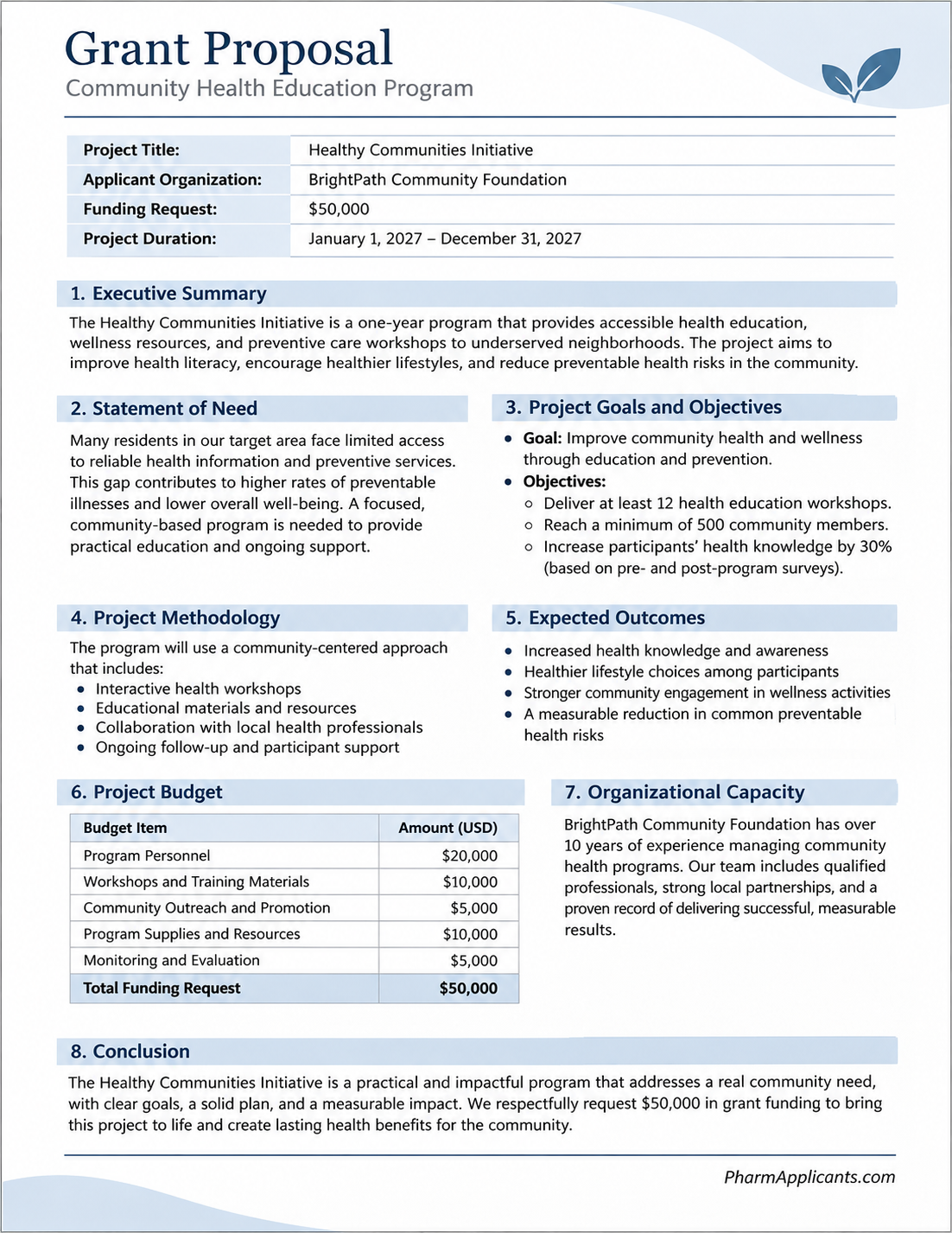
Project Title: Healthy Communities Initiative
Applicant Organization: BrightPath Community Foundation
Funding Request: $50,000
Project Duration: January 1, 2027 – December 31, 2027
Executive Summary: The Healthy Communities Initiative is a community-based program designed to improve health awareness through educational workshops, wellness resources, and preventive health activities. The project aims to reach underserved neighborhoods and provide residents with practical information that supports healthier lifestyles.
Statement of Need: Many residents in the target communities have limited access to reliable health education and preventive resources. The proposed initiative will address this gap through accessible learning opportunities and community engagement.
Project Objectives:
- Organize at least 12 health education workshops.
- Reach a minimum of 500 community members.
- Improve participants’ health knowledge through educational activities.
Project Methodology: The organization will conduct interactive workshops, distribute educational materials, collaborate with local health professionals, and provide follow-up support to participants.
Expected Outcomes: The project expects to increase health awareness, encourage healthier lifestyle choices, and strengthen community participation in preventive health activities.
Proposed Budget:
- Program personnel: $20,000
- Workshops and training materials: $10,000
- Community outreach and promotion: $5,000
- Program supplies and resources: $10,000
- Monitoring and evaluation: $5,000
Total Funding Request: $50,000
Conclusion: The Healthy Communities Initiative offers a practical approach to addressing local health education needs. With financial support, the organization aims to deliver meaningful educational opportunities and create lasting benefits for the community.
This example is for educational purposes only. Actual grant proposals should be customized to match the funder’s requirements, project objectives, and verified organizational information.
Common Grant Proposal Mistakes to Avoid
Even a valuable project can receive a negative evaluation if its proposal is unclear or incomplete. Avoid these common mistakes when preparing your funding application:
- Unclear project objectives: Avoid vague goals that cannot be measured or evaluated.
- Insufficient evidence: Support your statement of need with credible data and relevant information.
- Unrealistic budgets: Make sure all costs are reasonable and properly explained.
- Poor alignment with funder priorities: Do not submit a generic proposal without considering the funder’s specific interests.
- Missing information: Check that every required document and proposal section is included.
- Late submission: Allow sufficient time for revisions and submit before the application deadline.
Frequently Asked Questions About Grant Proposals
1. What is the main purpose of a grant proposal?
The main purpose of a grant proposal is to persuade a potential funder to provide financial support for a specific project or program. It explains the project’s need, objectives, activities, budget, and expected outcomes.
2. What are the main sections of a grant proposal?
Most grant proposals include an executive summary, statement of need, project goals and objectives, methodology, timeline, budget, organizational background, expected outcomes, evaluation plan, and conclusion.
3. How long should a grant proposal be?
The length depends on the funding organization’s requirements and the complexity of the project. Some applications require only a few pages, while larger funding opportunities may require more detailed proposals and supporting documents.
4. What makes a grant proposal successful?
A successful grant proposal clearly explains an important need, presents realistic objectives, provides a detailed implementation plan, includes an accurate budget, and demonstrates that the applicant can achieve measurable results.
5. Can individuals apply for grants?
Yes. Some grant programs accept applications from individuals, including students, researchers, artists, entrepreneurs, and professionals. However, eligibility depends on the specific funding opportunity.
6. What is the difference between a grant proposal and a grant application?
A grant proposal is the document that presents a project’s purpose, plan, budget, and expected results. A grant application is the broader submission process, which may include the proposal, application forms, supporting documents, and other required information.
7. Should a grant proposal include a budget?
Yes, most grant proposals require a detailed project budget. It shows how much funding is needed, identifies expected expenses, and explains how the money will support project activities.
8. Can I use the same grant proposal for different funders?
You can reuse relevant project information, but you should customize each proposal to match the funder’s priorities, eligibility requirements, application guidelines, and preferred format.
Conclusion
A well-prepared grant proposal can help turn a valuable idea into a realistic project by securing the financial resources needed for implementation. It should clearly explain the project’s purpose, demonstrate the need for funding, present achievable objectives, and provide a transparent budget.
By following a structured format, researching potential funders, and presenting measurable outcomes, you can create a more professional and persuasive funding request. Use the sample grant proposal in this guide as a starting point, and adapt it to your project’s specific needs and the funder’s requirements.
Download: Grant Proposal Template Word
